In a jet pump artificial lift system, the fluid dynamics are the heart of how lift is achieved. At its core, the system uses the Venturi effect—a high-velocity jet of power fluid entrains and lifts produced fluid from the reservoir. Here’s how the flow physics break down:
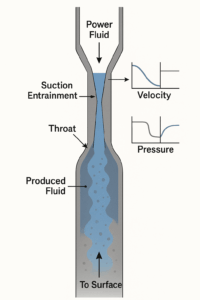
1. Nozzle Acceleration
The surface pump pressurizes the power fluid (water, treated produced water, or oil) and sends it downhole through tubing or annulus to the jet pump.
- In the nozzle, the power fluid’s pressure energy is converted into velocity.
- This creates a high-velocity jet stream exiting into the throat section.
- The governing principle here is Bernoulli’s law: pressure drops as velocity increases.
2. Suction Entrainment
The low pressure at the nozzle exit (caused by acceleration) induces a suction effect.
- This suction draws the formation fluid (produced oil, gas-cut liquid, or water) into the pump body.
- Entrainment occurs at the nozzle–throat interface, where the jet shears and mixes with reservoir fluid.
- The ratio of nozzle area to throat area (N/T ratio) controls how much reservoir fluid can be drawn in for a given jet velocity.
3. Mixing in the Throat
In the throat, power fluid and produced fluid mix turbulently.
The high-momentum jet transfers kinetic energy to the produced fluid.
Mixing equalizes velocities, but at the expense of some energy loss (turbulent dissipation).
4. Diffuser Pressure Recovery
After mixing, the two-phase stream passes into the diffuser.
- The diffuser gradually increases cross-sectional area, decelerating the flow.
- By Bernoulli’s principle, velocity decreases and pressure is recovered.
- This recovered pressure must exceed the hydrostatic head and friction in the production conduit to lift fluid to surface.
5. Surface Separation & Recycle
At the surface:
- The mixture is separated in a power-fluid separator.
- Produced fluid goes to sales or treatment.
- Clean power fluid is filtered, pressurized again by the surface pump, and recirculated downhole.
6. Key Governing Parameters
- Nozzle–throat ratio: Determines entrainment capacity and efficiency.
- Power fluid pressure & flow: Must balance hydrostatic head, tubing friction, and reservoir inflow.
- Density & viscosity of fluids: Affect jet momentum transfer, mixing efficiency, and energy losses.
- Backpressure at surface: Controls diffuser performance and stability.
- Gas content: Free gas in either power fluid or produced fluid reduces efficiency and may cause cavitation.
7. Efficiency Considerations
- Jet pumps typically achieve 20–35% hydraulic efficiency, lower than mechanical pumps, but they are prized for reliability, no moving downhole parts, and flexibility.
- Efficiency depends on operating in the right envelope of nozzle pressure, flow rate, and throat sizing.
- Too high a nozzle pressure → erosion and wasted energy.
- Too low a nozzle pressure → poor entrainment and low lift.
Simplified Energy Picture
- Surface pump: Converts mechanical shaft power → hydraulic energy in power fluid.
- Nozzle: Converts pressure → velocity (kinetic energy).
- Throat: Transfers kinetic energy → entrains produced fluid.
- Diffuser: Converts velocity → pressure (recoverable lift).